


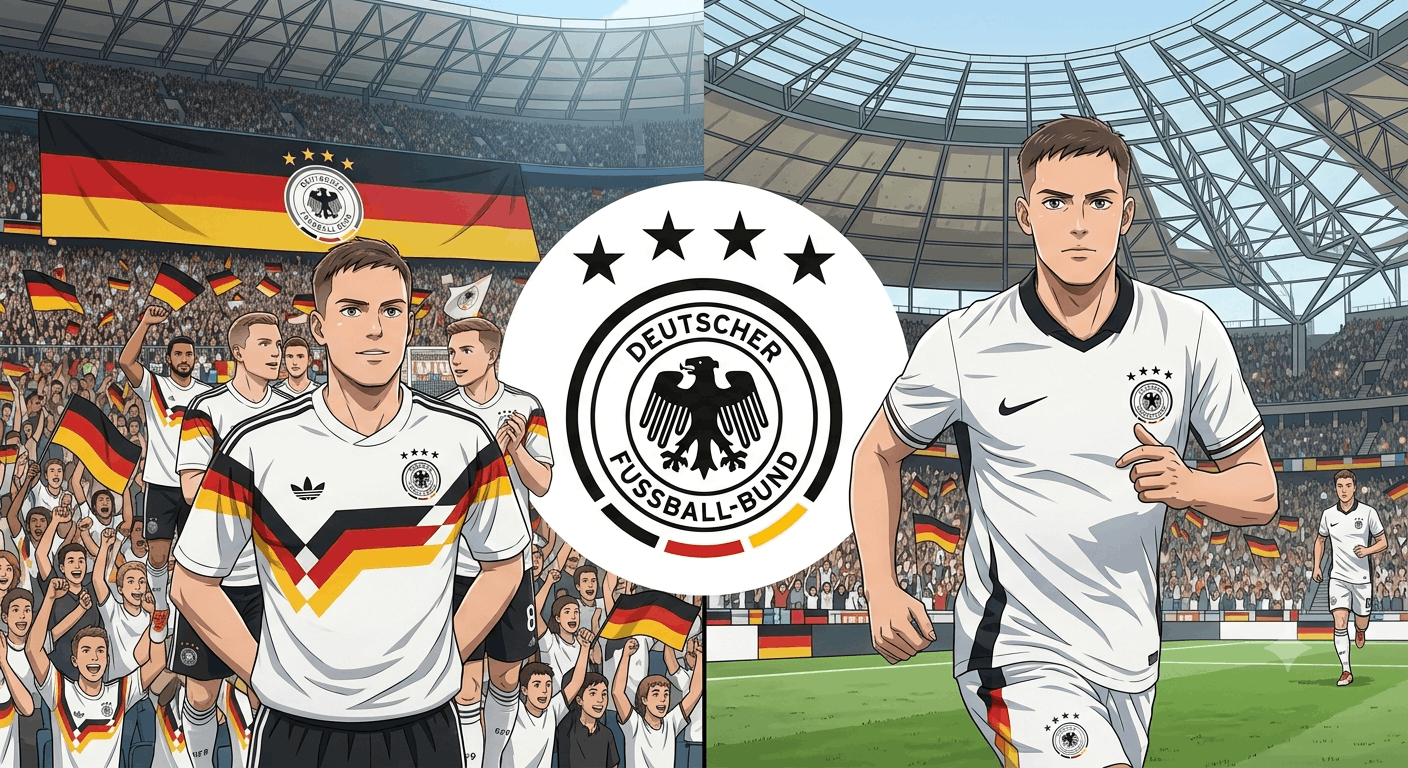
Last June and July, all football fans around the globe were rejoicing, as the 2026 FIFA World Cup was underway at the stadiums of USA, Mexico and Canada. One of the most successful teams in the history of the competition, although it was eliminated early from this year’s tournament, is the German National Football Team, which some months ago was making the sports headlines, not because of its’ performance on the pitch, but due to the new sponsorship kit deal that they made, which marked the end of a more than seventy-year partnership with Adidas.
Their relationship dates back to 1954 FIFA World Cup in Switzerland, when the founder of the brand, Adi Dassler, personally supported the then West German team by supplying innovative screw‑in studs that helped them win its first World Cup. Since then, the Adidas kit accompanied four men’s and two women’s World Cup titles and three men’s and eight women’s European Championships, making the brand an indispensable part of the German football identity.
Despite the emotional bond, the Adidas contract is legally ending on 31 December 2026, so the German and EU competition rules required the German Football Association (DFB) to run an open, non‑discriminatory tender process, rather than automatically renewing with their current supplier. The tender formally opened in January 2024, and several major sports brands submitted proposals, but Nike’s offer was financially unmatched, offering over 100 million euros per year for a seven-year contract, roughly doubling the Adidas’ existing deal per year. Consequently, the DFB clearly and repeatedly stated that Nike have submitted the best financial offer by far, therefore they were awarded the contract.
From the above case study, which shook the world of sports, there are surely lessons that all Sales professionals could take. Primarily, despite Adidas having an undoubtedly successful long-term performance, a deep emotional connection and heritage, they still lost the deal, proving that in Sales, no account is “safe”. Thus, as Salespeople we should never assume that loyalty equals retention, since, most probably, our key accounts are always in the process of listening to competitors and evaluating alternatives. From our side, we need not rely on past success but focus on the future and treat long-term customers as new prospects.
From Nike’s point of view, they not only took part in the tender process, but chose the right moment to bid, as it was known that the DFB had financial issues, in conjunction with the fact that the performance of the men’s national team was steadily declining. This meant that the DFB needed to reset their narrative, so they were more open to change. Therefore, Nike’s pitch, which was personally presented from their CEO, apart from the financial aspect, went beyond the kit, as it included an investment in grassroots and amateur football and a long-term support for women’s football, along with a global branding campaign designed to make the German players “global heroes”. Salespeople must always ask themselves if their potential customers are in a “change window” and look for triggers such as leadership changes, budget cuts etc. Winning a deal is not just what we sell, but when we sell it.
Despite losing the tender and one of their major accounts, Adidas have chosen to exit with professionalism rather than defensiveness. Therefore, they are staying fully committed until the expiry of the contract on December 31st, as they have leveraged their last year commercially with special kits and campaigns, protecting their brand equity. In this way they have maximised value until the very last day and leave the door open for future business.
In my view, this story proves clearly that in Sales, history helps, but it doesn’t always close deals. Just like in football, a team may dominate during the whole game but still lose to a last-minute goal from the opponent. The switch was not about poor performance or dissatisfaction with the current supplier, but rather a cold, strategic business decision driven by finances which lead to long-term security, along with the need to create a new vision and change the narrative. To win in Sales, among others, we need to continuously create value, have a sharp awareness of the business environment and be present so that once the opportunity arises, we score.